How to Read a Tire Sidewall: Size, Load Rating & DOT Date Codes Explained
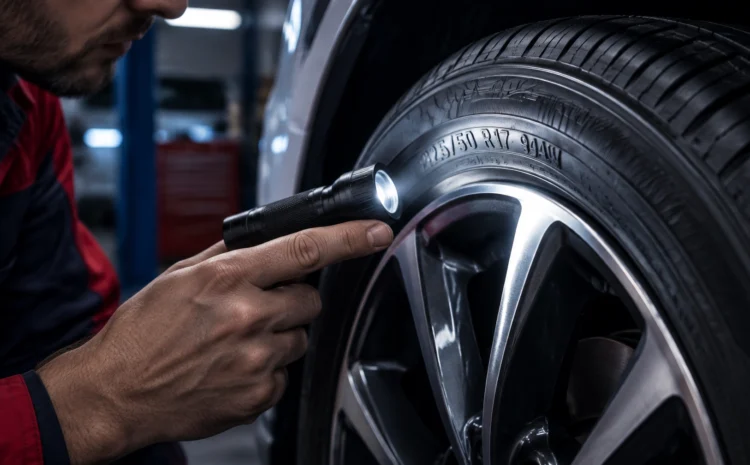
SE HABLA ESPAÑOL! Confused by the numbers and letters molded into your tire? You are not alone. A tire sidewall contains important information about fit, carrying capacity, speed, age, weather performance, and condition.
This guide explains the most common markings in plain English. It can help you compare tires, check an older set, and ask better questions when visiting a tire shop in Maryville, TN or the surrounding Alcoa area.
If any marking is difficult to read, stop by Universal Tire Tire Center. We can read the sidewall with you and help confirm whether a tire is appropriate for your vehicle.
START WITH THE TIRE SIZE
A common tire size looks like this:
235/60R17 102H
Each part provides a different specification.
235, TIRE WIDTH
The first number is the tire’s section width in millimeters.
In 235/60R17, the tire is approximately 235 millimeters wide from sidewall to sidewall when properly mounted and inflated.
A wider tire is not automatically better. Your vehicle’s suspension, wheels, fenders, and manufacturer specifications determine which sizes fit safely.
60, ASPECT RATIO
The second number is the aspect ratio. It tells you the sidewall height as a percentage of the tire’s width.
For 235/60R17, the sidewall height is about 60% of 235 millimeters.
A lower aspect ratio usually means a shorter sidewall. A taller sidewall may provide more cushioning over rough pavement. Never change this number without confirming that the new overall tire diameter and fit are correct.
R, RADIAL CONSTRUCTION
The letter R means radial construction. Most modern passenger-car, truck, and SUV tires use radial construction.
You may also see additional letters:
- P, Passenger tire
- LT, Light Truck tire
- XL: Extra Load or reinforced tire
- ST, Special Trailer tire
These markings matter. A passenger tire and a light-truck tire are not interchangeable in every application.
17, WHEEL DIAMETER
The final number in the main size group is the wheel diameter in inches.
A tire marked R17 fits a 17-inch wheel. It will not fit correctly on a 16-inch or 18-inch wheel.
UNDERSTAND LOAD INDEX AND SPEED RATING
The numbers and letter after the tire size are often the load index and speed rating.
In 235/60R17 102H:
- 102 is the load index.
- H is the speed rating.
LOAD INDEX
The load index is a standardized number that represents how much weight one tire can carry at its specified pressure.
The number is not the weight itself. It must be checked against a load-index chart or the tire manufacturer’s information.
When replacing tires:
- Match or exceed the vehicle manufacturer’s original load index.
- Do not select a lower load index just because the tire fits the wheel.
- Consider passengers, cargo, towing, and the vehicle’s gross weight.
- Check the driver’s door-jamb label and owner’s manual before buying.
Load capacity also depends on inflation pressure and tire application. When in doubt, have a professional confirm the correct tire.
SPEED RATING
The speed rating is shown by a letter. It indicates the tire’s tested ability to handle sustained speed under specified conditions.
Common ratings include:
- T, Approximately 118 mph
- H, Approximately 130 mph
- V, Approximately 149 mph
- W, Approximately 168 mph
- Y, Approximately 186 mph
These are not recommended driving speeds. They are test classifications. Road conditions, traffic, weather, tire condition, and local speed limits always come first.
For most replacements, the speed rating should meet or exceed the vehicle manufacturer’s specification. A tire with a higher rating is not automatically the best choice for every driver, so match the complete tire specification rather than focusing on one letter.
FIND THE DOT DATE CODE
Look for the letters DOT followed by a series of letters and numbers. The final four digits identify the tire’s manufacturing date.
For example:
- DOT … 2422 means the tire was made during the 24th week of 2022.
- DOT … 1025 means the tire was made during the 10th week of 2025.
The first two digits identify the week. The last two identify the year.
The complete DOT code may appear on only one side of the tire. If you cannot find the four-digit date code on the outside-facing sidewall, a technician may need to inspect the inside sidewall.
WHY TIRE AGE MATTERS
A tire’s age is based on its manufacturing date, not the date you bought it. Rubber changes over time, even when a tire has plenty of visible tread.
Inspect a tire carefully for:
- Dry cracking between tread blocks
- Cracks around the lettering or bead
- Bulges or bubbles
- Exposed cords
- Severe hardening
- Uneven wear
- Repeated air loss
- Vibration that was not present before
There is no single visual inspection that can guarantee an older tire is safe. Many manufacturers recommend professional inspection after several years of service and replacement by around 10 years from the manufacturing date, regardless of tread appearance. Follow the tire manufacturer’s guidance and have older tires evaluated.
READ UTQG RATINGS
Many passenger tires include a UTQG marking. UTQG stands for Uniform Tire Quality Grading.
You may see something like:
400 A A
This includes three ratings.
TREADWEAR
The treadwear number is a comparative rating. A higher number generally indicates greater tested wear resistance than a lower number.
However, it is not a guaranteed mileage rating. Driving habits, alignment, inflation, road surfaces, maintenance, climate, and tire design all affect actual tread life.
Use treadwear numbers to compare similar tires. Do not treat them as a promise that a tire will last a specific number of miles.
TRACTION
The traction grade is usually AA, A, B, or C. It relates primarily to wet braking performance in standardized testing.
A higher grade may be useful when comparing tires, but the rating does not describe every aspect of handling. It does not directly measure snow, ice, cornering, or hydroplaning performance in every condition.
TEMPERATURE
The temperature grade is usually A, B, or C. It reflects the tire’s ability to resist heat buildup under controlled testing.
Inflating a tire correctly is still essential. A temperature rating does not protect a tire from the hazards of underinflation, overloading, excessive speed, or damage.
CHECK THE MAXIMUM INFLATION PRESSURE
The sidewall may show a maximum pressure and maximum load. This is not always the correct pressure for your vehicle.
For everyday inflation, use the pressure listed on the vehicle manufacturer’s door-jamb label or in the owner’s manual. That recommended pressure is selected for the vehicle’s weight, handling, braking, and ride characteristics.
Remember:
- Check pressure when tires are cold.
- Do not use the sidewall maximum as the normal setting unless the vehicle manufacturer specifies it.
- Check all four tires, including the spare if equipped.
- Inspect for slow leaks when one tire repeatedly loses pressure.
For help with tire pressure monitoring and related service, see our tire and TPMS services.
KNOW THE M+S AND THREE-PEAK MOUNTAIN SNOWFLAKE MARKINGS
M+S OR M&S
M+S means Mud and Snow. This marking generally indicates a tread pattern designed to provide better traction in light mud and snow than a standard highway pattern.
It does not guarantee strong performance in deep snow, ice, or severe winter conditions. It also is not the same as a standardized severe-snow test.
THREE-PEAK MOUNTAIN SNOWFLAKE
The Three-Peak Mountain Snowflake symbol shows a mountain with three peaks and a snowflake inside.
This marking indicates that the tire has passed a standardized severe-snow traction test. It is commonly found on winter and some all-weather tires.
If you regularly drive through snow or colder mountain conditions, the Three-Peak Mountain Snowflake marking provides more useful information than M+S alone. For typical East Tennessee driving, also consider wet roads, temperature changes, and the vehicle’s normal use.
LOOK FOR OUTSIDE, INSIDE, AND DIRECTIONAL MARKINGS
Some tires are designed to mount in a specific position.
OUTSIDE AND INSIDE
An asymmetrical tire may show:
- OUTSIDE: This side must face outward.
- INSIDE: This side must face toward the vehicle.
Mounting the tire backward can affect how the tread performs in wet conditions and how the tire wears.
ROTATION ARROWS
Directional tires may have an arrow and the word ROTATION. The arrow must point in the direction the tire turns when the vehicle moves forward.
These markings should be checked during installation or tire rotation. If a tire is mounted incorrectly, do not simply drive on it and hope for the best. Have it corrected.
WHEN SIDEWALL MARKINGS MEAN REPLACE, NOT REPAIR
A puncture in the repairable area of the tread may sometimes be professionally repaired. Sidewall damage is different.
A tire should generally be removed from service when it has:
- A sidewall puncture or cut
- A visible bulge or bubble
- Exposed cords
- Deep cracking or dry rot
- Severe impact damage
- Tread separation
- Damage caused by driving while severely underinflated
- Tread at or below the wear indicators
- Age or condition concerns identified during inspection
A plug or patch cannot restore the strength of a damaged sidewall. Oops: trying to save a tire with structural damage can create a serious safety risk.

USE THE SIDEWALL AS A STARTING POINT
Sidewall markings help you understand what a tire is designed to do. They do not replace the vehicle manufacturer’s specifications or a professional inspection.
Before purchasing tires in Maryville, TN, check:
- Correct size
- Correct load index
- Appropriate speed rating
- Reasonable DOT date
- Matching construction and application
- Proper winter markings for your driving conditions
- No cracks, bulges, or other visible damage
If you are comparing new tires in Alcoa, TN, bring the information from your current tire and door-jamb label. Our team can help compare the specifications and explain your options without making the process confusing.
GET HELP READING YOUR TIRES
Understanding a tire sidewall can help you avoid an incorrect size, an unsuitable load rating, or an older tire that needs closer inspection. But you do not have to decode every marking alone.
Universal Tire Tire Center is a locally owned, family-operated shop serving drivers in Alcoa, Maryville, and nearby communities. If you are unsure what your tire numbers mean, stop by or contact us. We will read the sidewall with you and help determine whether the tire needs service, replacement, or a closer safety inspection.
For available options, you can also review our new tire services or new and professionally inspected used tires. Call us for current inventory and straightforward guidance.